
European Heritage Days in Montpellier: 20 places to visit on 19–20 September 2026
Once a year, Montpellier opens the doors it keeps closed the rest of the time: a former prison turned dance studio, a 13th-century Jewish ritual bath, a Gothic cathedral tower, a city hall designed by Jean Nouvel. Almost all of it is free. If you’ve just moved here, this is the best weekend of the year to understand the city from the inside. We checked all 20 visits one by one. Booked slots go fast — start with the first list. 1. Book now The mikveh — 1 rue de la Barralerie A 13th-century Jewish ritual bath, among the best preserved in Europe. Saturday and Sunday, 10am–7pm, 20-minute slots. Free, booking on Billetweb. Access down 15 steps. City Hall — 1 place Georges Frêche Jean Nouvel’s blue building, from the main hall to the council chamber, guided by city staff. Saturday and Sunday, 10am–1pm and 2–6pm. Free, book on Billetweb. Wheelchair accessible. The Rectorat (regional education authority) — 31 rue de l’Université Five centuries of university history, three inner courtyards and the council room. Four slots Saturday, two Sunday. Free, book online, 30 people per group. Lycée Georges Frêche — 401 rue Le Titien The hospitality school designed by Massimo Fuksas: four training restaurants, a teaching hotel. Guided by tourism students. Saturday only, departures every 30 minutes from 9:30am to 3:30pm. Free, booking via the Weezevent link on the official listing. The Grand Tour, from La Panacée to MO.CO. — 14 rue de l’École de Pharmacie The former royal college of medicine, now a contemporary art centre. Sunday only, 11am–12:30pm. Free, book by email: mocoreservation@moco.art. Hôtel Saint-Côme — 32 grand rue Jean Moulin France’s first anatomy amphitheatre, under its restored dome. Saturday, slots every 30 minutes from 10am to 5:30pm. Free, booking required (Billetweb / Tourist Office). Heritage Concert — Opéra Comédie, place de la Comédie Shekhar, Mozart and Prokofiev, conducted by Eduardo Strausser, with a pre-concert meeting with the musicians. Friday 18th at 8pm, Saturday 19th at 7pm. €16 flat rate, Opera box office. 2. Free entry, no booking Agora, International Dance Centre — 2 bd Louis Blanc A former convent, then a prison, now home to Montpellier Danse. Courtyard, studios, theatre and cells. Saturday and Sunday 2–6pm. Enter through the blue door. Wheelchair accessible. The Court of Appeal — 1 rue Foch The renovated courthouse, with judges and clerks on hand to explain their work. Saturday only, 9:30am–5pm. Wheelchair accessible. Urbain V tower, Saint-Pierre Cathedral — place Saint-Pierre A rare opening. Saturday 2:30–4pm, Sunday 2:30–5:30pm. Groups of 18, first come first served. 204 steps; not open to under-12s, pregnant women or people with heart conditions; cancelled in rain, storms or extreme heat. Saint-Pierre Cathedral (self-guided) — place Saint-Pierre Southern Gothic, begun in 1364. Saturday 2:30–4pm, Sunday 2:30–6pm. Chapelle des Pénitents blancs — 14 rue Jacques Cœur Nicknamed the “Sistine Chapel of Languedoc” for its painted ceiling and gilded woodwork; the ongoing restoration is now visible. Friday 10am–noon and 2–7pm, Saturday and Sunday 10am–7pm. Chapelle des Pénitents bleus — 11 rue des Étuves Neo-Gothic, with an 1891 Puget organ and over 1,000 votive offerings. Sacred song concerts and an organ hour. Friday 2–7pm, Saturday and Sunday 10am–7pm. Donation-based, entry subject to capacity. Wheelchair accessible. Dominican convent — 8 rue Fabre The order has been in Montpellier since 1220. Saturday 10am–noon and 2–6pm, Sunday 10am–noon and 4–6pm, with a classical concert on Sunday at 4pm. Notre-Dame des Tables basilica — place Notre-Dame Guided tour of the Baroque church, its paintings and furnishings. Saturday, 3:30–4:30pm only. Saint-Roch church — place Saint-Roch A stop on the Camino de Santiago, dedicated to the city’s patron saint. Saturday 11am–12:30pm and 2–6pm, Sunday 2–6pm (no morning session). Wheelchair accessible. An 18th-century mansion: Hôtel Cambacérès-Murles — 3 rue Sainte-Croix Courtyard and monumental staircase by Jean Giral, 1723. Saturday and Sunday 10am–6:30pm. A guardhouse at the Peyrou — place royale du Peyrou The north guardhouse, normally closed, with an exhibition on the square’s history. Saturday and Sunday 10am–1pm and 2–6pm. Wheelchair accessible. The city walls — 12 bd Henri IV The last surviving stretch of the medieval wall, presented by the Barons de Caravètes association. Saturday only, 10am–5:30pm. 3. A short tram or car ride away Lattara archaeological site — 390 route de Pérols, Lattes A major ancient Mediterranean port, from the 6th century BC to the 2nd century AD. Saturday and Sunday, five guided tours a day (10:30am, noon, 1:45pm, 3:30pm, 5pm). Free, sign up on site on the day, 60 people per slot. Espace Père Soulas exhibition — Saint-Étienne church, Viols-le-Fort (25 km) Eighty objects belonging to Father André Soulas, in a church restored by volunteers. Saturday, 10am–noon and 2–4pm. Ten visitors at a time, wheelchair accessible, parking 50 m away. Three tips before you go New to Montpellier? This weekend is a good way to see the city differently — and to meet other newcomers. Find our outings and our support at newhere.fr: we help you settle in, and feel at home here. Full programme at journeesdupatrimoine.culture.gouv.fr. Information checked on 14 September 2026; times and availability may change.
September in Montpellier: the events you shouldn’t miss
Moving to a new city usually starts with the same question: where do I begin? In Montpellier, September answers it for you. In three weeks the city packs in music festivals, buildings that stay closed the rest of the year, and film premieres. It is the best month to get to know the place — and to meet people without having to try too hard. Here are five events we recommend, with the practical details you need to get there. 1. Beer Love Fest — grand finale at the Peyrou, 11 and 12 September Montpellier’s craft beer festival turns ten this year. After a week of events in partner bars across the metropolitan area, everything wraps up on the Promenade du Peyrou, one of the finest viewpoints in the city. Our tip: come on Saturday. Entry is free, the daytime atmosphere is family-friendly, and it is by far the easiest setting to start a conversation with the people next to you. 2. Festival Arabesques — until 20 September Now in its 21st edition, Arabesques brings the cultures of the Arab world into dialogue with the contemporary scene: world music, jazz, stand-up, exhibitions and talks, spread across the Opéra Comédie, the Domaine d’O and the Halle Tropisme. Don’t skip La Médina, the festival’s social space, with homemade gazelle horns, makrouts, snowballs, cigares and Moroccan pancakes. Open Thursday and Friday from 6.30pm, Saturday 2pm to midnight, Sunday 2pm to 11pm. 3. European Heritage Days — 19 and 20 September This is the weekend Montpellier opens the doors that stay shut all year. The city of private mansions unlocks several of them, and this year devotes one of the densest programmes in the country to photography. Rarely open: the medieval mikveh on rue de la Barralerie, a 12th-century Jewish ritual bath and one of the best preserved in Europe; the Hôtel de Grave and Hôtel de Villarmois; the Hôtel d’Aurès and the garden of the former bishop’s palace; the Hérault prefecture; the Costumotek and its stock of over ten thousand costumes; the Droguier of the pharmacy faculty; and Pierresvives, the Zaha Hadid building. The classics: eight sessions at the Musée Fabre including “Design according to Pierre Paulin”, five at the Opéra Comédie with backstage access, the Bonnier de la Mosson estate and its pocket concerts, and Saint-Pierre cathedral with its Urbain V tower and organ. With kids: a family visit for ages 6–10, “The painter and his materials”, at the Musée Fabre, “Contes en vadrouille” story readings, and the “Agence NO-FUTUR” workshop. The two 2026 themes: photographic heritage, centred on Pierresvives with the Hérault departmental archives (including a cyanotype workshop), and heritage at risk, with the secrets of restored artworks at the Musée Fabre. Good to know: several visits require booking. Check the conditions on each listing and book early — slots go fast. 4. Les Internationales de la Guitare — from 20 September The festival takes over as the Heritage Days end and runs through to 18 October. Its promise: an eclectic, demanding programme in which the guitar is the thread running between very different genres — classical, jazz, contemporary and world music. 5. Cinemed — the premieres start in September The Mediterranean Film Festival runs from 16 to 24 October for its 48th edition, with a poster paying tribute to Spanish director Pablo Berger and Camélia Jordana among the guests. Expect more than 200 screenings, filmmaker Q&As and cultural events. Tickets for the premieres and festival passes are already on sale. The first screening is on Thursday 17 September at the Médiathèque Émile Zola with Nabil Ayouch’s Everybody Loves Touda, followed by L’Affaire Marie-Claire on Saturday 17 October and En haut de la pile on Monday 19 October, both at the Corum. Website: cinemed.tm.fr The real challenge: not going alone Finding a festival is easy. Going when you don’t know anyone is a different matter — and it is usually what separates “I saw a concert” from “I had a great night”. At New Here we organise outings and meetups so you can discover Montpellier as part of a group, from your very first weeks here. Join our next event Browse the upcoming New Here outings and book your spot. You’ll leave with new places to go back to, familiar faces and the start of a local network. See upcoming events
Make your (first) “Fête de la musique” unforgetable !
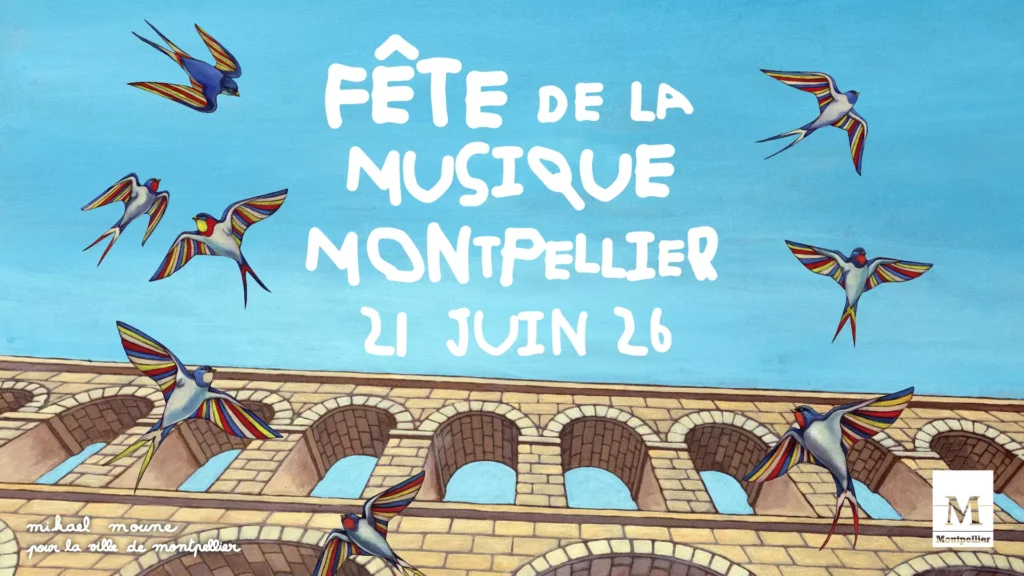
Every year on June 21st, Montpellier turns into one giant open-air stage. Fête de la Musique — France’s national music celebration — fills the city with free concerts, street performances, and spontaneous sounds from dusk until well past midnight. For anyone who has recently arrived in Montpellier, it is one of the best ways to feel the city come alive. Here’s how to make the most of it. The Official Programme: 4 Stages, All Free The City of Montpellier organises an official lineup every year across four iconic venues. No tickets, no wristbands — just show up. Esplanade du Peyrou — the main stage The centrepiece of the evening. From 6:30pm to 12:30am, the grand esplanade hosts a diverse and ambitious lineup: Between headliners, BülBül Elektro keeps the energy going with their Balkan electro-oriental sound. The setting alone is worth the trip: the Peyrou esplanade, facing the aqueduct, under the night sky. Kiosque Bosc — Esplanade Charles de Gaulle A more intimate stage, running from 6pm to midnight. Opens with Nanasso, a guitarist rooted in the local Romani tradition, then moves through a strong selection of emerging local artists (Mathilde Bonami, Keed, Miszellany) before closing with indie-rock acts Loons and Avalon Bloom. Don’t miss rapper Oley’s carte blanche set at 9:15pm. Maison des Chœurs A quieter, more contemplative programme: pop choral groups, classical choral music, Mediterranean and Oriental songs, and Ukrainian polyphonies directed by Igor Mykhailevsky. A programme that reflects Montpellier’s remarkable cultural diversity. Musée Fabre — worth planning ahead Sameer Ahmad, a respected figure in French rap, performs a unique concert inside the museum’s permanent collection from 4pm. Free entry with a museum ticket, limited capacity. Full programme at montpellier.fr. The Unofficial Programme: Just Walk This is where Montpellier truly shows its character. Beyond the official stages, dozens of informal concerts spring up across the city: bars, small squares, narrow streets, and inner courtyards throughout the old centre. A guitarist under an archway, a jazz band at a street corner, a choir on a neighbourhood square. There is no complete map. That’s the point. The rule is simple: walk. Areas worth exploring on foot: The site openagenda.com/fr/fetedelamusique2026 lists some of the registered unofficial concerts, but the real discoveries happen when you step outside without a plan.